
March 22, 2026
Custom millwork has its own language, and the first time you see it, it can feel a little overwhelming. You open a quote or look at a drawing, and suddenly, there are terms you have never heard before, even though the people working on your project use them every day.
The good news is you only need to learn it once. Once you understand what these terms actually mean, you start to see the project more clearly. You can read drawings without second-guessing, compare proposals more accurately, and make decisions with a lot more confidence.
Quick Millwork vs Casework
Many homeowners see both terms used in project documents. While they are related, they describe slightly different categories of work.

The Plain-English Difference
Millwork typically refers to custom-built architectural woodwork that is produced in a specialized shop and installed in the home. Examples include paneling, built-in cabinetry, custom trim, mantels, and architectural details.
Casework generally refers to modular cabinet units used for storage, such as kitchen cabinets, bathroom vanities, or built-in shelving. These pieces may be custom or semi-custom, but they are typically constructed as box units that are installed together. In residential projects, custom cabinetry is often considered part of millwork when it is designed and built specifically for the home.
Quote and Contract Terms

Allowance
An allowance is a placeholder amount in the budget for a material or item that has not yet been selected. A quote may include a hardware allowance of $20 per pull. If the final hardware selection costs more or less than the allowance, the final price will adjust accordingly.
Alternate
An alternate is an optional item listed separately in a quote. It provides pricing for an alternative design or material choice. A project might include an alternate price for walnut cabinetry instead of painted maple.
Exclusion
An exclusion identifies work that is not included in the contract scope. This helps prevent confusion about responsibilities between trades. Electrical work for cabinet lighting may be listed as an exclusion if it will be completed by another contractor.
Lead Time
Lead time refers to the time required to produce materials or fabricate millwork before installation can begin. Custom cabinetry and architectural millwork often require several weeks for fabrication after drawings are approved.
Change Order
A change order documents any modification to the original contract after work has begun. This may involve design changes, material substitutions, or scope adjustments. Change orders typically include both cost adjustments and timeline updates.
Drawing and Measurement Terms

Elevation
An elevation is a flat drawing that shows a vertical view of a wall or millwork installation. Cabinet elevations illustrate the arrangement of doors, drawers, panels, and trim from the front.
Section
A section drawing shows a cut-through view of a cabinet or assembly. This perspective reveals internal construction, materials, and connections that are not visible from the exterior. Sections are often used to explain joinery, shelf placement, or hardware installation.
Detail
A detail drawing enlarges a specific part of a design to show how components come together. A molding profile or cabinet door construction may be illustrated in a detailed drawing.
Field Verify
When drawings include the note field verify, it means the installer must confirm measurements at the job site before fabrication or installation proceeds. This step ensures that millwork fits accurately once walls, flooring, and other elements are complete.
Finished Floor (FF) and Finished Height (FH)
Finished Floor (FF) refers to the final floor surface after flooring materials are installed. Finished Height (FH) indicates the height of an element relative to that finished floor surface. These reference points help maintain consistent installation dimensions across a project.
Fit and Finish Terms
Reveal
A reveal is the small visible space between two adjacent surfaces. For example, inset cabinet doors often have a consistent reveal between the door edge and frame. Carefully controlled reveals create a refined and balanced appearance.
Scribe
To scribe means to cut or shape a panel so it fits tightly against an irregular wall surface. Since walls are rarely perfectly straight, scribing allows cabinetry or trim to meet the wall cleanly without visible gaps.
Filler
A filler is a narrow strip of material used to close small gaps between cabinetry and adjacent walls or appliances. Fillers also provide clearance for cabinet doors and drawers to open fully.
Toe Kick
The toe kick is the recessed space at the bottom of base cabinets. This indentation allows people to stand closer to countertops without hitting the cabinet face with their feet. Typical toe kick dimensions are about 3 to 4 inches deep and 3 to 4 inches high.
Crown and Light Rail
Crown molding is decorative trim installed at the top of cabinets or paneling where it meets the ceiling. A light rail is a smaller molding installed beneath wall cabinets to conceal under-cabinet lighting fixtures.
Paneling and Applied Molding
Paneling refers to decorative wall surfaces made from wood panels or millwork components. Applied molding describes decorative trim pieces attached to flat panels to create raised or framed visual patterns.
Materials and Finish Terms
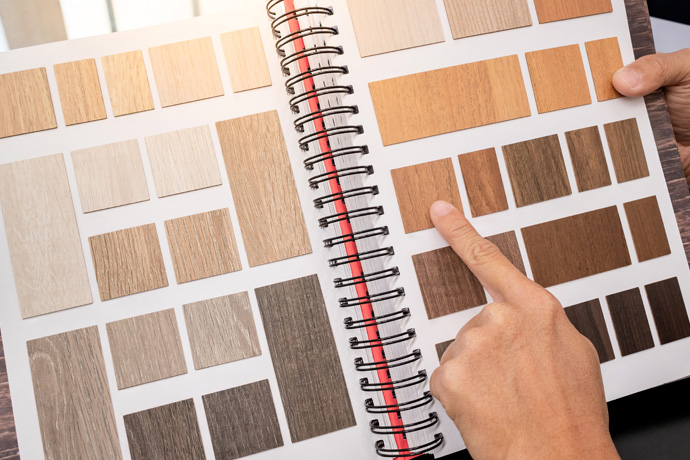
Veneer
A veneer is a thin layer of real wood applied to a stable substrate such as plywood or MDF. Veneers allow designers to achieve the appearance of solid wood while improving dimensional stability.
MDF
Medium-density fiberboard (MDF) is an engineered wood product made from compressed wood fibers and resin. It has a very smooth surface, which makes it ideal for painted finishes.
Plywood
Plywood is constructed from thin layers of wood veneer bonded together with alternating grain direction. This cross-layer construction provides strength and stability, making plywood a common choice for cabinet boxes.
Plastic Laminate
Plastic laminate is a durable surface material composed of resin-infused layers bonded under pressure. It is commonly used for countertops, cabinet interiors, and high-traffic surfaces.
Sheen (Matte, Satin, Semi-Gloss)
Sheen describes the level of reflectivity in a finish.
-
Matte: very low reflectivity
-
Satin: soft, low-luster appearance
-
Semi-gloss: higher reflectivity with increased durability
Satin finishes are often used for cabinetry because they balance durability and visual softness.
Stain vs Paint vs Clear Coat
Stain adds color while allowing the natural wood grain to remain visible.
Paint creates an opaque surface that hides the wood grain.
Clear coat is a transparent protective finish applied to natural wood.
Hardware and Function Terms
Soft-Close
Soft-close hardware uses dampened hinges or slides to prevent doors and drawers from slamming shut.
Full Overlay vs Inset
Full overlay cabinets have doors that cover most of the cabinet face frame. Inset cabinets have doors that sit flush within the frame opening, requiring precise craftsmanship and tighter tolerances.
Full Extension Slides
Full extension drawer slides allow drawers to open completely so the entire drawer box is accessible.
Touch Latch
A touch latch mechanism allows cabinet doors to open with a light push instead of a handle or pull.
Pull-Out Accessories
These accessories improve storage accessibility. Examples include pull-out pantry shelves, trash systems, spice racks, and tray dividers.
One-Page Cheat Sheet
When reviewing millwork drawings or quotes, these are the key terms homeowners benefit from understanding.
The 15 Terms to Know Before You Approve Drawings
-
Allowance: A set amount of money included in the quote for something not fully chosen yet, like hardware or finishes.
-
Alternate: An optional version of part of the project that you can choose instead of the main option, usually with a different price.
-
Lead time: The amount of time it takes from ordering something to it being delivered or ready.
-
Change order: A written update to the project when something changes after work has already started, often affecting cost or timeline.
-
Elevation: A straight-on drawing of a wall or surface that shows what it will look like from the front.
-
Section: A cut-through drawing that shows what something looks like inside or how different parts are put together.
-
Field verify: A note to double-check measurements on-site before building or installing something.
-
Reveal: The small, intentional gap or visible edge between two surfaces, often used for a clean, modern look.
-
Scribe: Cutting or shaping a piece so it fits perfectly against an uneven wall or surface.
-
Filler: A small piece added to fill gaps between cabinets or between a cabinet and a wall.
-
Toe kick: The recessed space at the bottom of cabinets where your feet go when you stand close.
-
Veneer: A thin layer of real wood applied over another material to give it the look of solid wood.
-
MDF: A smooth, engineered wood made from compressed fibers, often used for painted cabinets and panels.
-
Full overlay vs inset: Full overlay means cabinet doors cover most of the frame, while inset means the doors sit flush inside the frame.
-
Full extension slides: Drawer hardware that lets the drawer pull all the way out so you can easily access everything inside.
Understanding these terms makes it much easier to interpret drawings and ask informed questions during your project.
At Joseph A. Interiors, we believe transparency and education are part of exceptional craftsmanship. When homeowners understand the language behind millwork design, the entire process becomes smoother and more collaborative. If you have questions about drawings, materials, or specifications, our team is always happy to guide you through every detail.
Custom millwork is already a statement of craftsmanship. When paired with thoughtful lighting, it becomes immersive, functional, and emotionally resonant. If you’re planning a luxury renovation, boutique retail space, or simply want to elevate your interiors with detail-driven design, we’d love to talk. Let’s bring your vision to life!
- Share:
-

-

-

-


