
April 15, 2026
The way students learn has changed fundamentally over the past two decades. Rigid rows of desks facing a chalkboard gave way to flexible clusters. Quiet libraries evolved into dynamic media centers. Technology moved from the computer lab into every corner of the building. And through all of it, the physical environment either supported that evolution or worked against it.
Custom millwork is one of the most powerful tools available to educational designers and facility planners trying to build spaces that genuinely serve modern learners. When it's done well, it's invisible in the best possible way: students and teachers simply find that the space works, that there's a place for everything, that the room can shift to meet the moment, and that the environment itself communicates care and intention.
Evolving Learning Environments and the Need for Custom Millwork
The modern classroom is no longer a single-purpose room. It's a flexible environment that might host direct instruction in the morning, small-group collaboration after lunch, and independent project work by the end of the day.
Standard furniture and off-the-shelf casework were designed for a model of education that fewer schools still practice. Custom millwork is designed around the model schools are actually using.
Understanding the full range of millwork types available is a useful starting point for educational facility planners. From casework and cabinetry to architectural paneling and built-in furniture elements, the vocabulary of custom millwork is broad, and the right combination of solutions depends entirely on the specific needs of each space.
Flexibility and Collaborative Zones
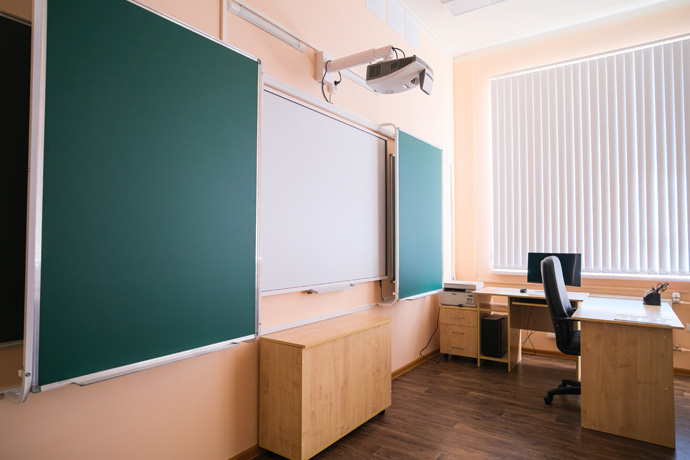
The most effective modern classrooms are zoned rather than uniform. A flexible classroom might have a direct instruction area near the board, a cluster zone for group work, a quiet independent work corner, and a maker-style project space along one wall, all within a single room. Custom millwork makes those zones legible and functional without making them permanent.
Built-in storage walls that define a zone without closing it off. Mobile casework on locking casters that can be repositioned as the lesson demands. Work surfaces at varied heights that accommodate different ages and learning postures. Display and presentation surfaces are integrated into millwork elements so they don't consume floor space.
The design of collaborative zones also benefits from thinking carefully about sightlines. Teachers need to maintain awareness of the full room even when working with a small group. Millwork elements that create zones without creating blind spots serve both pedagogical and supervisory needs, a balance that requires intentional design rather than improvisation.
Integrating Technology and Acoustic Solutions
Technology integration in educational millwork goes well beyond cutting a hole for a cord. Modern classrooms require power and data access at multiple points throughout the room, integrated charging storage for device carts, display mounting solutions that don't compromise wall surfaces, and teacher workstations that consolidate control of room technology in a way that doesn't overwhelm the teaching position.
Custom millwork addresses all of this from the inside out. Power and data runs are planned during fabrication, not retrofitted afterward. Device storage is built to the actual dimensions of the tablets or laptops the school uses. Teacher stations are designed around real workflows rather than generic assumptions.
Acoustic performance is equally important and often underaddressed in educational settings. Hard, parallel surfaces create reverberation that makes it genuinely difficult for students, particularly those with hearing differences or auditory processing challenges, to understand instruction clearly.
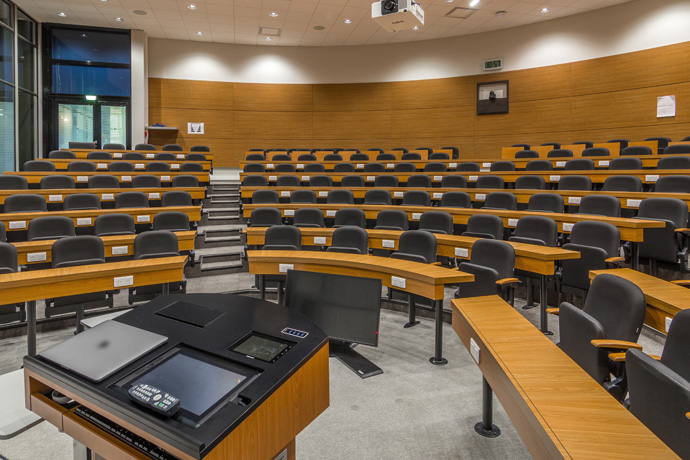
Wall and ceiling paneling systems designed with acoustic properties in mind can dramatically improve the listening environment of a classroom without sacrificing the visual quality of the space. Perforated panels, fabric-wrapped elements, and strategic placement of absorptive surfaces are all tools that belong in the educational millwork conversation.
Custom Libraries and Media Centers
The school library has undergone perhaps the most dramatic transformation of any educational space over the past generation. What was once a quiet room of shelves and study tables is now, in the best schools, a media center, a maker space, a research hub, a reading retreat, and a collaborative project room, sometimes all at once.
Custom millwork is what allows a single space to hold all of those identities gracefully. The principles that apply to redefining office spaces with custom millwork translate directly here: thoughtful zoning, integrated technology, purposeful storage, and design that elevates the experience of the people using the space every day.

Built-In Shelving and Reading Nooks
A well-designed library shelving system does more than store books. It organizes a space, creates navigable zones, establishes sightlines for supervision, and contributes to an environment that communicates the value of reading and learning. Custom built-in shelving allows all of those functions to be designed together rather than assembled from separate catalog purchases that never quite cohere.
Height matters in educational shelving. Elementary library shelving needs to be accessible to small children without compromising the organizational logic of the collection. Middle and high school libraries can accommodate taller configurations but benefit from varied heights that break up the visual monotony of a long row and create natural stopping points for browsing.
Reading nooks deserve particular attention in educational library design. A well-crafted built-in reading alcove, with comfortable seating, good light, and a sense of enclosure that signals permission to slow down and stay a while, can become the most beloved spot in a school building.
The design principles that make a home library with custom shelving feel warm and inviting translate beautifully into educational settings, scaled and adapted for the specific needs of the age group being served.
Window seats with built-in storage below, alcove seating tucked between shelving units, stepped platform reading areas with cushioned surfaces: these are elements that cost relatively little compared to their impact on how students relate to a library space.
Children who feel welcomed and comfortable in a library use it more. That outcome is worth designing for intentionally.
Safe and Durable Materials for Schools
Educational environments place exceptional demands on their interiors. Surfaces get bumped, scratched, written on, and cleaned repeatedly. Materials that perform beautifully in a boutique office or luxury hospitality setting may not hold up to a day in a middle school hallway.
High-pressure laminates in appropriate grades, solid surface materials at high-touch points, and edge profiles that resist chipping and delamination are among the right choices for educational millwork. Rounded edges and corners are both a durability consideration and a safety one, particularly in elementary settings.
Substrate selection matters as well: materials that maintain structural integrity under humidity fluctuations and temperature swings, both common in older school buildings, perform far better over time than those optimized purely for initial appearance.
Finish selection in educational settings also benefits from thinking about the full lifecycle of the installation. A finish that's easy to clean, resistant to common chemicals found in school cleaning protocols, and forgiving of minor surface damage without showing wear dramatically reduces the total cost of ownership over the life of the millwork.
Budgeting and Project Planning for Educational Millwork
Working With School Boards and Funding Cycles
School construction and renovation projects operate on budget cycles that are often determined months or years before a project begins. Referendum funding, state aid allocations, and capital improvement budgets all have specific timelines, approval processes, and documentation requirements.
Early engagement is particularly important in educational projects. Millwork that's specified early in the design process can be value-engineered thoughtfully, with the full picture of budget constraints and design priorities in view.
Millwork that's specified late tends to get cut, simplified, or rushed, and the compromises made under those conditions are often ones the school lives with for decades.
Phasing is a strategy worth building into educational millwork plans from the beginning. A school that can't fund a complete library renovation in a single cycle might fund the shelving and casework in year one, the reading nook built-ins in year two, and the media center millwork elements in year three.
Designing with that phasing in mind from the start ensures that each phase integrates with the next rather than creating a patchwork result.
Lead times are a recurring source of difficulty in educational projects, where summer construction windows are narrow, and the consequences of missing a school-year opening are significant. Custom millwork fabricated to educational-grade specifications requires realistic lead times, and projects that treat fabrication as a last-mile detail rather than a critical-path item frequently run into trouble.
At Joseph A. Interiors, we work with school districts, architects, and construction managers across Wisconsin who understand that educational environments deserve the same quality of craft and intentionality that any premium commercial project receives.
If you're planning an educational facility project and want to talk through how custom millwork can serve your students and your budget, we'd welcome that conversation.
Custom millwork is already a statement of craftsmanship. When paired with thoughtful lighting, it becomes immersive, functional, and emotionally resonant. If you’re planning a luxury renovation, boutique retail space, or simply want to elevate your interiors with detail-driven design, we’d love to talk. Let’s bring your vision to life!
- Share:
-

-

-

-


