
April 15, 2026
Healthcare environments ask more of their interiors than almost any other setting. Every surface endures constant use, rigorous cleaning protocols, and the scrutiny of patients who are often anxious, unwell, and acutely aware of their surroundings. Every workstation needs to support clinical workflows that, when disrupted, have real consequences for staff and patients alike.
The Role of Custom Millwork in Healthcare Design
Off-the-shelf furniture and standard casework were never designed for the complexity of a modern medical environment. Healthcare facilities have highly specific workflow requirements, strict compliance standards, and a responsibility to patients that demands more than a catalog solution can deliver.
Custom millwork for commercial projects allows designers and facility planners to build around the actual needs of a space rather than adapting their needs to whatever's available. In healthcare, that distinction matters enormously.
The difference between a nurse station designed around real clinical workflows and one that simply occupies the right square footage can be measured in staff efficiency, error rates, and patient outcomes.
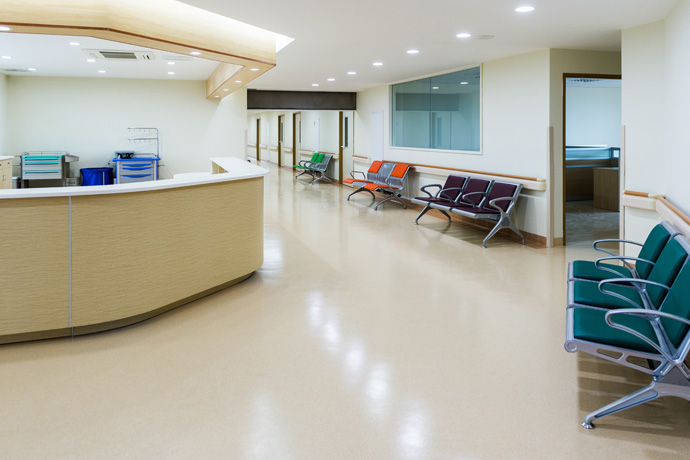
Patient-Focused Nurse Stations and Workflows
The nurse station is the operational core of any clinical floor, and its design has a direct impact on the quality of care patients receive. When a station is poorly configured, staff spend time compensating for it: walking farther than necessary, working around inadequate storage, and struggling to maintain line-of-sight to patient rooms.
A well-designed custom nurse station eliminates friction. It places the right storage exactly where it's needed. It creates sightlines that allow staff to monitor patient areas without leaving their workstation. It integrates technology, power, data connections, and task lighting in a way that supports clinical work rather than cluttering it. It does all of this while meeting the dimensional and ergonomic requirements that allow staff to work comfortably across long shifts.
Architectural millwork at this level requires close collaboration with clinical staff, not just designers and architects. The people who use these stations every day often have the most valuable insight into what works and what doesn't, and incorporating that knowledge into the design process consistently produces better outcomes than designing from the outside in.
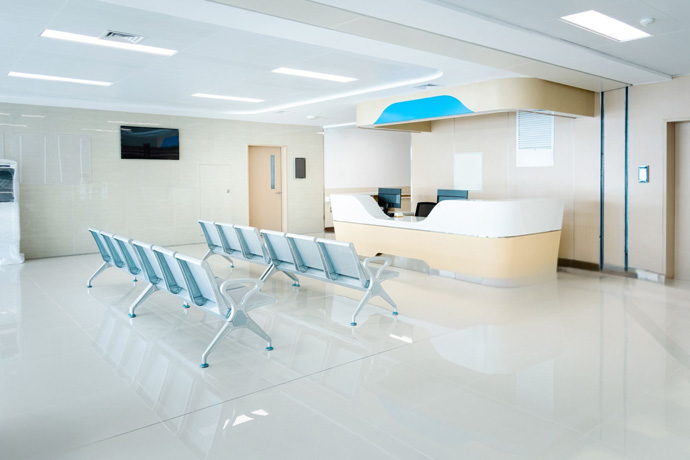
Reception Desks and Waiting Areas That Welcome and Inform
A patient's first impression of a healthcare facility begins the moment they walk through the door. For many people, that moment carries real anxiety. The design of a reception area either eases that anxiety or compounds it.
A custom reception desk in a healthcare setting needs to accomplish several things simultaneously. It needs to present as warm and welcoming rather than institutional. It needs to support the administrative workflows of the staff behind it, with integrated storage, transaction surfaces at appropriate heights, and space for technology that doesn't create visual clutter.
It should also communicate competence and care. Patients are making a judgment about their provider from the moment they arrive. Waiting areas deserve the same deliberate attention. Built-in seating elements, millwork display cases, reception counters, and wayfinding elements all contribute to an environment that either feels considered or feels assembled
Infection-Control Materials and Finishes for Medical Facilities
Material selection in healthcare millwork is not purely an aesthetic decision. It carries clinical weight. Surfaces that are difficult to clean, that harbor bacteria, or that degrade under repeated disinfection protocols create real infection-control risks. This is an area where cutting corners is genuinely not an option.
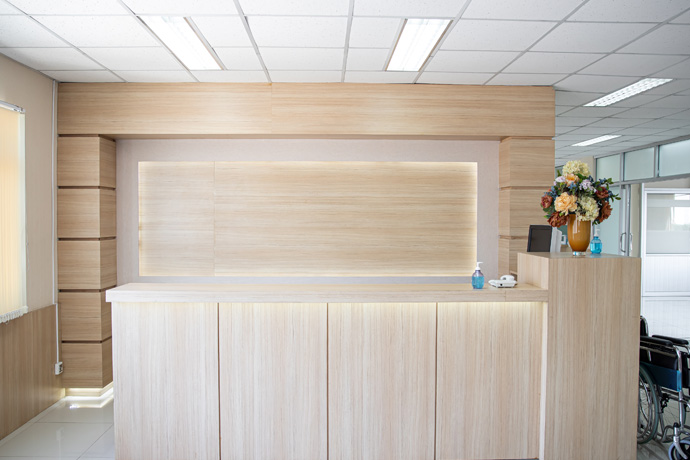
High-Durability Surfaces and Easy-Cleaning Laminates
The materials specified for healthcare millwork need to perform under conditions that would compromise standard commercial finishes. High-pressure laminates with seamless edges, solid surface materials, and antimicrobial-treated substrates are among the options that meet healthcare-grade durability and hygiene standards.
Edge profiles matter as well: designs that eliminate crevices, recesses, and porous joints give bacteria fewer places to accumulate and cleaning staff fewer obstacles to work around.
Our finish durability guide covers how different materials perform in high-touch environments, and the principles apply directly to healthcare settings where the demands are even more rigorous.
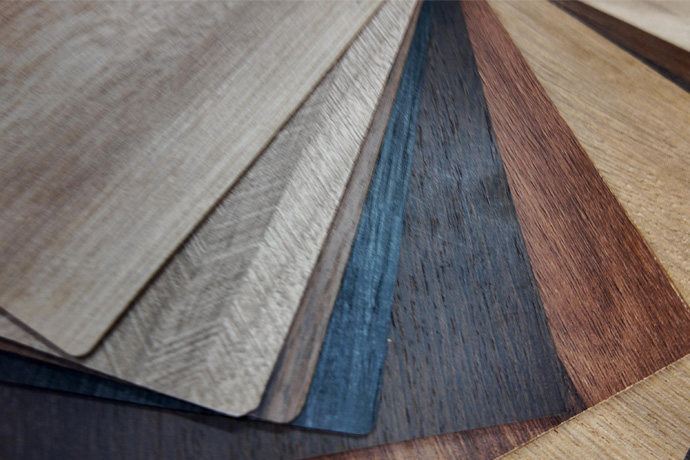
Color and finish also play a role in infection control that's often underappreciated. Matte and satin finishes tend to show contamination more readily than gloss surfaces, which can actually support cleaning protocols by making soiling more visible. Lighter base tones in clinical areas serve a similar function.
Understanding architectural woodwork grades and AWI QCP standards is essential context for healthcare millwork procurement. Grade specifications determine construction quality, finish standards, and performance expectations, and in a regulated environment, having documented quality standards on record is both professionally sound and practically valuable.
Planning and Budgeting a Healthcare Millwork Project
Healthcare millwork projects operate within a set of constraints that go well beyond aesthetics and budget. Regulatory requirements, infection-control standards, ADA compliance, and the operational realities of a functioning medical facility all shape what's possible and what's required.
Coordination with Architects, Engineers, and Compliance Teams
Successful healthcare millwork projects are never designed in isolation. They're the product of close, sustained coordination between the millwork team, the project architect, structural and MEP engineers, infection-control specialists, and, in many cases, clinical leadership and facilities management.
That coordination needs to start early. Millwork that's specified after the architecture is finalized often runs into conflicts: structural elements in the wrong place, mechanical runs that limit cabinetry depth, and ceiling heights that don't accommodate the planned nurse station configuration.
Budget planning for healthcare millwork requires honesty about the full scope of what's being specified. Healthcare-grade materials, custom fabrication, and the coordination complexity of a regulated environment all carry a premium over standard commercial millwork.
Lead times are another planning consideration that healthcare projects frequently underestimate. Custom millwork, particularly at healthcare-grade specifications, takes time to fabricate properly. Projects that plan for standard lead times and then discover they need extended timelines face difficult choices.
Partnering with a Millwork Expert in Wisconsin
Healthcare millwork is a specialty within a specialty. It requires fluency in clinical workflow design, regulatory compliance, infection-control materials science, and the craft of high-quality custom fabrication. Finding a partner who brings all of those capabilities to the table, and who has a documented track record of delivering them, is the most important decision a healthcare design team will make.
At Joseph A. Interiors, we bring decades of experience in custom commercial millwork to healthcare projects across Wisconsin. We understand the standards these environments demand, and we know how to navigate the coordination complexity of a healthcare construction or renovation project without disrupting the operations of a functioning facility.
We work closely with architects, interior designers, and facilities teams from early design through installation, contributing millwork expertise at every stage where it's most valuable. Our fabrication quality meets AWI standards. Our material specifications are selected for genuine healthcare-grade performance. Our project management is built around the reality that healthcare facilities operate on tight schedules with real consequences for delays.
The details matter in healthcare. We're in the business of getting them right.
Custom millwork is already a statement of craftsmanship. When paired with thoughtful lighting, it becomes immersive, functional, and emotionally resonant. If you’re planning a luxury renovation, boutique retail space, or simply want to elevate your interiors with detail-driven design, we’d love to talk. Let’s bring your vision to life!
- Share:
-

-

-

-


